
Batch
Batch association
The public record associates an exact catalog product with the batch identifier shown on that route.
Nexus publishes normalized batch records with reported HPLC purity, mass-spectrometry identity fields, retention time, and batch traceability. Each page states the public evidence boundary: the Nexus record is not an original laboratory report or instrument trace.
A Nexus Certificate of Analysis (COA) page is a normalized, batch-level record for a research compound. A finalized record can publish HPLC, mass-spectrometry, or additional screening fields only where they are present for the represented lot. Pending records remain clearly labeled and do not expose assay values. The public page is a Nexus summary of fields on record; it is not an original laboratory report or raw instrument file.
For field-level interpretation, read the purity vs assay and net peptide content guide. HPLC area percent, assay language, and net-content wording stay separate until a finalized batch record visibly states the field.
Five evidence layers stay visible as one record story: the product and batch association, reported HPLC purity, mass-spectrometry identity fields, any additional panels, and the public COA state.
A clean run shows one dominant peak for the target compound and minor impurity peaks. The dominant peak area relative to total integrated area is reported as HPLC purity.
View published COAsBatch
The public record associates an exact catalog product with the batch identifier shown on that route.
Purity
A finalized record can publish the reported HPLC area-percent purity, method, and specification held for that named batch.
Identity
Where present on a finalized record, observed mass is shown beside expected molecular mass as the reported identity evidence for that batch.
Screen
Where present, fields such as endotoxin are shown as separate batch-record evidence.
Archive
Finalized Certificates of Analysis link from product pages and resolve through batch verification URLs. Pending certificates remain clearly labeled and no login is required.
Evidence boundary
Verified lots retain their batch status and reported analytical fields in a public Nexus COA record.
Inspect public batch recordsA finalized status means the catalog record is tied to a specific batch and carries reported analytical fields. The public page exposes only the identifiers, methods, values, criteria, and dates actually held for that represented record.
The current public dataset does not identify the originating laboratory, document an accreditation scope, expose a task number or verification key, or link the original report and raw instrument files. Nexus therefore does not attribute those records to a named partner or present the representative chromatogram as source data.
Finalized records can contain HPLC purity, MS identity, mass and retention fields, or additional screens. A field appears only when it is supported for that represented lot; no universal panel is inferred.
A COA is useful only when the reader understands what the measurements mean. HPLC stands for high-performance liquid chromatography. In a peptide purity run, the sample moves through a column while different components separate over time. The output is a chromatogram: a trace with peaks. A clean sample should show one dominant peak for the target compound and only small secondary peaks for related impurities or byproducts. The retention time is where the main peak appears on the time axis. The area under that main peak, compared with the total integrated peak area, is reported as area-percent purity.
That purity number is not the same as identity. A sample can produce one dominant HPLC peak and still be the wrong compound. Mass spectrometry adds the identity check by ionizing the molecule and measuring the mass-to-charge signal. The result is interpreted against the expected molecular mass for the compound. When the observed mass aligns with the expected mass within a tight error range, the report supports that the material in the vial is the intended molecule rather than a mislabeled or structurally different peptide.
When both fields are present, the chemistry story is layered: HPLC describes the purity profile of the sample, while mass spectrometry helps assess whether the measured material matches the expected molecule. A 99% HPLC result means the dominant integrated chromatogram peak accounts for roughly 99% of the measured peak area under that method. It does not mean every possible contaminant has been ruled out, and it does not replace identity confirmation. The right reading sequence is compound and batch ID first, HPLC purity and retention behavior second, mass identity fields third, and any additional panels such as endotoxin or microbial presence after that.
A purity number is most useful when it is connected to a specific lot, a stated method, and inspectable source evidence. Nexus COA pages expose the fields currently held in the batch record, but the normalized card is not a raw instrument file or the originating laboratory report. Its chromatogram is explicitly representative. When source attribution, accreditation scope, report identifiers, or original files are not public, those details are not inferred.
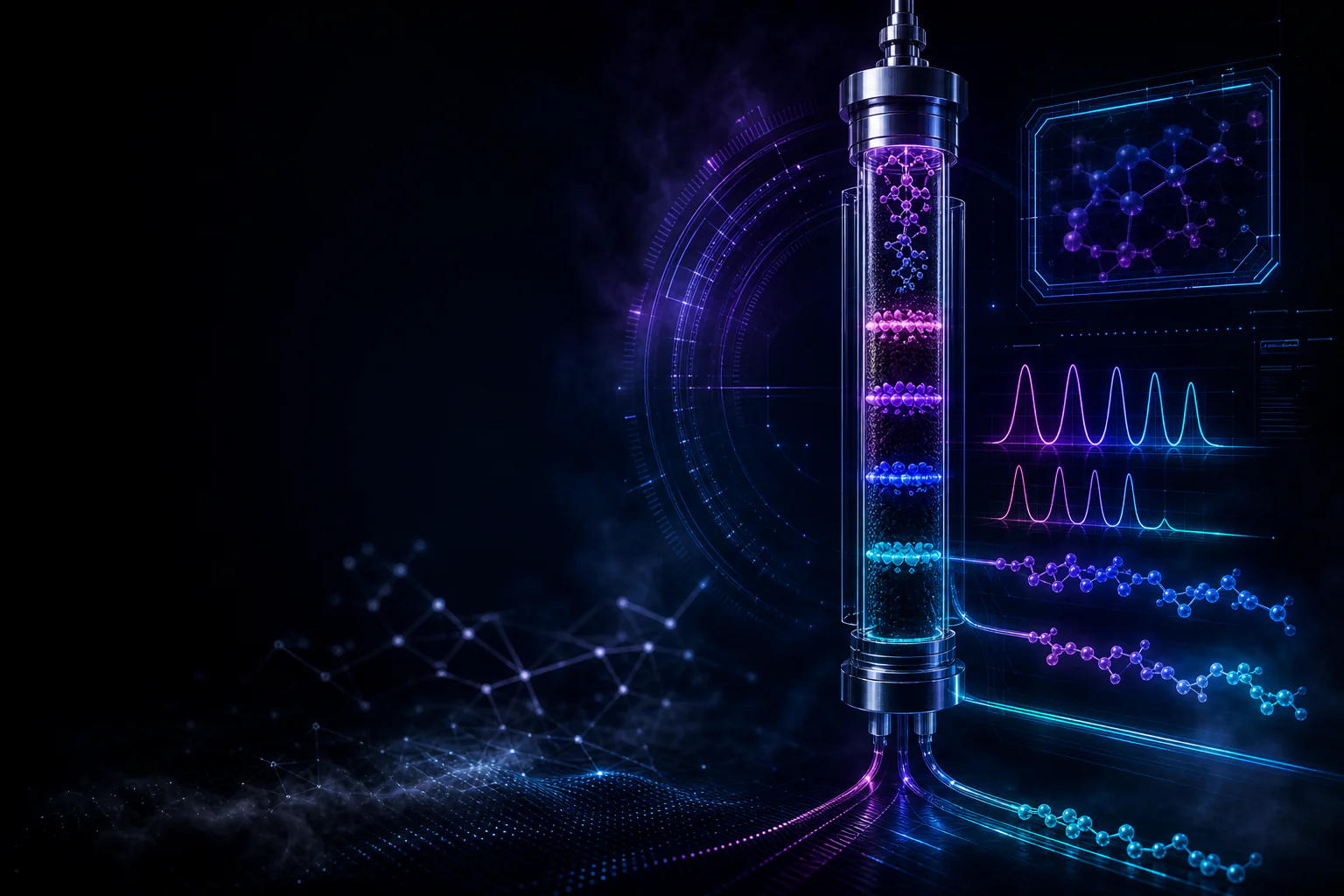
A sample moves through the column while related components separate into distinct signal bands.

The main integrated peak is compared with the total peak area to report area-percent purity.

Mass spectrometry checks whether the observed signal aligns with the expected molecule.

Read batch ID, HPLC purity, mass identity, and added panels as one layered record.

Additional screens such as endotoxin are read as separate context, not as a replacement for identity.
Each card below uses a finalized Nexus COA record. Open a card to read only the fields held for that represented lot. Where purity and retention are present, the trace is a clearly representative reading aid.
5 public COAs · Open record · Annotate fields5 public records · Tap Annotate COA for field notes · Open arrow for the full certificate
APX-2026-0405-B
This peak = reported purity. BPC 157 lot APX-2026-0405-B reports RP-HPLC purity at 99.65%, with the main peak retained at 12 min.
Batch ID ties the record to one represented lot; expected mass is 1419.53 Da and observed mass is 1419.50 Da.
BPC 157 lot APX-2026-0405-B is the record being annotated. The purity callout points to the 99.65% RP-HPLC result and 12 min retention time. The identity callout lists expected mass 1419.53 Da and observed mass 1419.50 Da.
APX-2026-0305-S
This peak = reported purity. Semaglutide lot APX-2026-0305-S reports RP-HPLC purity at 99.52%, with the main peak retained at 16.5 min.
Batch ID ties the record to one represented lot; expected mass is 4113.58 Da and observed mass is 4113.46 Da.
Semaglutide lot APX-2026-0305-S is the record being annotated. The purity callout points to the 99.52% RP-HPLC result and 16.5 min retention time. The identity callout lists expected mass 4113.58 Da and observed mass 4113.46 Da.
APX-2026-0428-R
This peak = reported purity. Retatrutide lot APX-2026-0428-R reports RP-HPLC purity at 99.49%, with the main peak retained at 17.8 min.
Batch ID ties the record to one represented lot; expected mass is 4731.33 Da and observed mass is 4731.50 Da.
Retatrutide lot APX-2026-0428-R is the record being annotated. The purity callout points to the 99.49% RP-HPLC result and 17.8 min retention time. The identity callout lists expected mass 4731.33 Da and observed mass 4731.50 Da.
APX-2026-0306-T
This peak = reported purity. Tirzepatide lot APX-2026-0306-T reports RP-HPLC purity at 99.55%, with the main peak retained at 17.5 min.
Batch ID ties the record to one represented lot; expected mass is 4813.53 Da and observed mass is 4813.72 Da.
Tirzepatide lot APX-2026-0306-T is the record being annotated. The purity callout points to the 99.55% RP-HPLC result and 17.5 min retention time. The identity callout lists expected mass 4813.53 Da and observed mass 4813.72 Da.
APX-2026-0404-A
This peak = reported purity. AOD9604 lot APX-2026-0404-A reports RP-HPLC purity at 99.63%, with the main peak retained at 13.5 min.
Batch ID ties the record to one represented lot; expected mass is 1815.07 Da and observed mass is 1815.16 Da.
AOD9604 lot APX-2026-0404-A is the record being annotated. The purity callout points to the 99.63% RP-HPLC result and 13.5 min retention time. The identity callout lists expected mass 1815.07 Da and observed mass 1815.16 Da.
48 finalized lot records are indexed below. Each link resolves to the lot-specific public COA; pending placeholders are intentionally absent.
Receipts, not promises. Nexus separates verified records from pending certificates by tying every public statement to the named batch, the visible certificate state, and the analytical fields actually on record.
Verified or pending
Each public Nexus lot record carries an explicit certificate state. Finalized records can display the analytical fields currently held for that named batch. Pending records confirm the product-batch association only and suppress unfinished assay values.
One record, one lot
A finalized result belongs to the batch named on that record. It is not transferred to a neighboring size, blend, product route, future lot, or the catalog as a whole. General method explainers never substitute for batch-specific evidence.
Summary, not raw report
The Nexus COA view is a normalized public record, not an originating laboratory report or raw instrument file. When a laboratory identity, accreditation scope, report identifier, source document, or raw trace is not public, the interface does not infer it.
Now that the proof system is visible, continue into the catalog and inspect each product's published certificate state and any finalized lot-specific record from the product page.