

MOTS-c
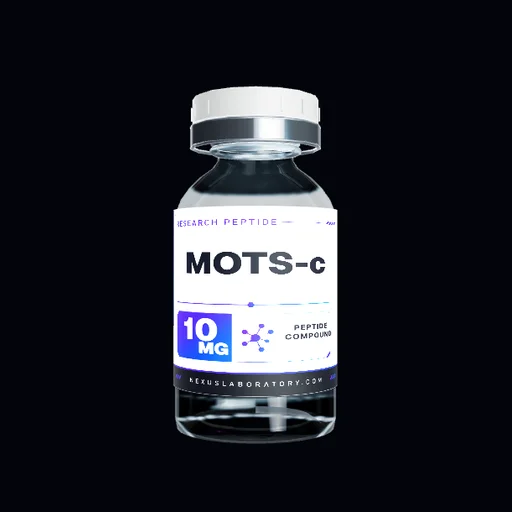
MOTS-c from the Nexus Longevity & Cellular Health catalog, supplied for controlled in-vitro research workflows.
Ships from the US with tracking.
Catalog active: Catalog pricing is active. Live warehouse counts are not published.
- Lot-specific COA
- HPLC + MS fields
- Batch archived
For in-vitro research use only. Not for human consumption.
Encoded in the mitochondrial 12S rRNA gene, MOTS-c is a 16-amino acid peptide. Laboratory research describes MOTS-c as activating AMPK signaling while regulating cellular metabolism, folate-methionine cycling, and de novo purine biosynthesis. In response to metabolic stress, MOTS-c can translocate to the nucleus and act as a mitochondrial-nuclear retrograde signal.
MOTS-c definition
MOTS-c is a 16-amino acid peptide encoded in the mitochondrial 12S rRNA gene. It activates AMPK signaling and regulates cellular metabolism, folate-methionine cycling, and de novo purine biosynthesis. MOTS-c can translocate to the nucleus in response to metabolic stress, acting as a mitochondrial-nuclear retrograde signal.
No sequence is listed in the current catalog record for this product.
- CAS
- N/A
- MW
- 2174.6 g/mol
- Sequence
- Not listed
- Half-life
- Not listed
- Formula
- Not listed
- Purity
- 99.84%
- Form
- Not listed
- Class
- Longevity & Cellular Health
The dossier.
Compound Overview
Encoded in the mitochondrial 12S rRNA gene, MOTS-c is a 16-amino acid peptide. Laboratory research describes MOTS-c as activating AMPK signaling while regulating cellular metabolism, folate-methionine cycling, and de novo purine biosynthesis. In response to metabolic stress, MOTS-c can translocate to the nucleus and act as a mitochondrial-nuclear retrograde signal.
Research Background & Published Literature
MOTS-c was discovered by Dr. Pinchas Cohen's lab at USC and published in Cell Metabolism (2015). Published research examines this compound as a mitochondrial-encoded hormone, or mitokine, in relation to systemic energy homeostasis, insulin sensitivity, and exercise-responsive metabolic signaling.
Researchers reviewing the literature around this compound can use the peer-reviewed resources below for additional context on mechanism of action, signaling pathways, and controlled laboratory research applications:
- Lee et al. (2015) — Cell Metab
- Kim et al. (2018) — Cell Metab
- Kumagai et al. (2021) — Am J Physiol Endocrinol Metab
Storage, Handling & Stability Guidelines
Use the applicable lot/source record for storage of unopened material. Any diluent selection, preparation, temperature, aliquoting, or post-reconstitution hold conditions must be established by a qualified laboratory under a validated SOP; this page does not establish a stability window.
- Keep ambient-temperature handling time as short as practical to support compound integrity.
- Reseal vials promptly after each withdrawal to limit moisture exposure.
- Use appropriate personal protective equipment and follow institutional chemical safety protocols at all times.
- For traceability, label aliquots with compound name, concentration, reconstitution date, and operator initials.
Quality Assurance & Lab Verification
A finalized public Certificate of Analysis is available for this catalog item. Review the public COA for the applicable lot. Lot-specific identifiers, assay values, and methods are maintained in that record and are not repeated in this product dossier.
Shipping
Orders ship within the United States via USPS; international orders are not accepted. Laboratories should follow their validated SOP together with any handling fields published for the represented product or lot; no universal prepared-solution condition is inferred here.
Compound details.
- Molecular Weight
- 2174.6 g/mol
- Molecular Formula
- C₁₀₁H₁₅₂N₂₈O₂₂S₂
- Class
- Mitochondrial-Derived Peptide (MDP)
Research context.
Discovered by Dr. Pinchas Cohen's lab at USC and published in Cell Metabolism (2015). Research examines its role as a mitochondrial-encoded hormone (mitokine) regulating systemic energy homeostasis, insulin sensitivity, and exercise-responsive metabolic signaling.
Verification standard.
Certificate information is lot-specific. A finalized public record shows only the methods, fields, and results present for that named lot. A pending certificate state exposes no assay values and must not be interpreted as analytical verification. Review Nexus lab verification.
Analytical record.
- Reported HPLC purity
- 99.84%
- Retention time
- 15.00 min
- Observed mass
- 2174.52 Da
- Batch
- APX-2026-0314-M
The normalized Certificate of Analysis publishes only the lot-specific fields represented in the public record. It is not an originating laboratory report or raw instrument file.
View certificate of analysis - batch APX-2026-0314-M- Sequence
- Not listed
- Model preview
- Unavailable
Molecular model preview is unavailable for this catalog record.
The chemistry.
Static molecular fallback shown because this catalog record does not include a sequence suitable for the amino-acid viewer.
Related research compounds
Comparable catalog records with published variants and certificate status.
- Longevity & Cellular HealthVerified batchHumaninPrice$136.99Formats1 size
Compare size options, price, and certificate status before opening the product record.
CAS 330936-69-1View product - Longevity & Cellular HealthVerified batchSS-31PriceFrom $47.99Formats2 sizes
Compare size options, price, and certificate status before opening the product record.
CAS 736992-21-5View product - Longevity & Cellular HealthVerified batchNAD+PriceFrom $25.99Formats4 sizes
Compare size options, price, and certificate status before opening the product record.
CAS 53-84-9View product - Longevity & Cellular HealthVerified batchEpithalonPriceFrom $44.99Formats3 sizes
Compare size options, price, and certificate status before opening the product record.
CAS 307297-39-8View product - Longevity & Cellular HealthVerified batchFOXO4Price$217.99Formats1 size
Compare size options, price, and certificate status before opening the product record.
CAS 2460055-10-9View product
MOTS-c research FAQ.
What is MOTS-c used for in research?
MOTS-c is supplied for controlled in-vitro research workflows in the Longevity & Cellular Health category. It is not labeled for human or veterinary use.
Does MOTS-c have a finalized analytical record?
MOTS-c has a finalized Nexus Lab Verified record that reports 99.84% HPLC area-percent purity for the represented batch. Other fields are shown only where present.
Which MOTS-c variants are published?
Published Nexus variants include 10mg, 40mg.
Does MOTS-c include a COA?
Yes. The current Nexus record links MOTS-c to finalized batch APX-2026-0314-M.